
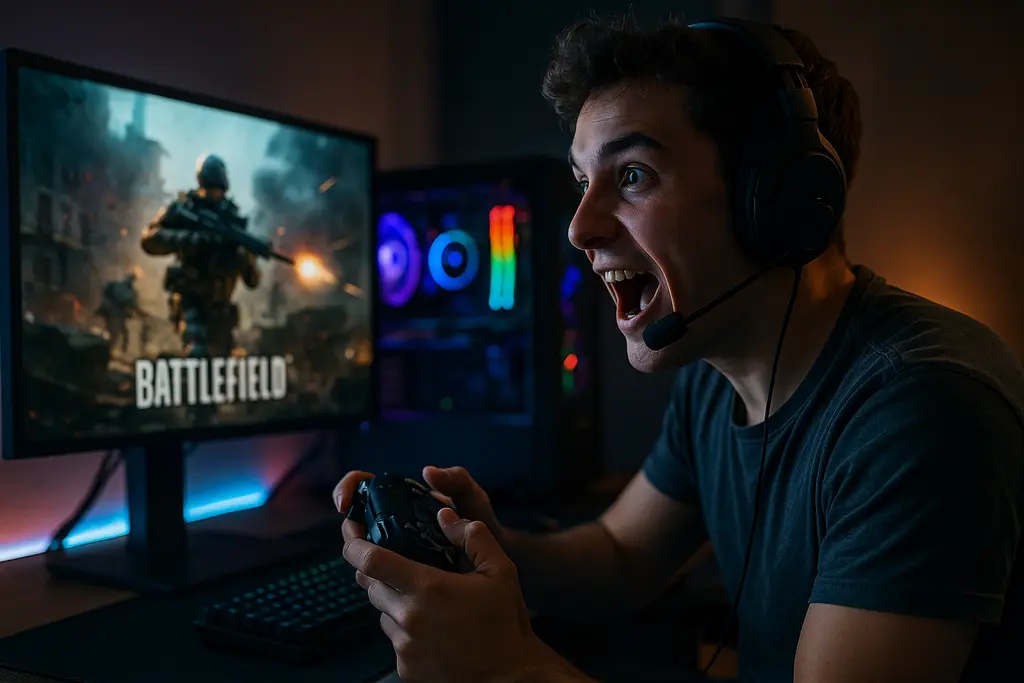

Proximity Chat is set to arrive in Battlefield 6 on September 15, 2026, with EA confirming that Season 4 Phase 3: Tidal Strike will introduce the feature through Battlefield Labs in Live for Battle Royale mode REDSEC first, according to the official EA community update. As of September 14, 2026, the feature is not active in the live game, so any judgment on match quality, abuse rates, or player adoption has to remain provisional.
That timing matters because EA is not presenting the voice feature as a finished social system across the whole game. It is being tested in a limited mode before any later expansion into Multiplayer modes. For players, that means the first few days should be treated less like a stable meta shift and more like a live test with real match stakes. Battle Royale is a sensible stress test: squads rotate under pressure, strangers may cross paths, and voice information can shape revive calls, ambushes, and disengagements.
The player-facing question is not only whether nearby voice makes REDSEC more entertaining. The sharper question is whether it improves useful communication without adding enough noise, harassment, or accidental open-mic clutter to make players turn it off. EA has said it will monitor audio range and clarity, player controls, moderation tools, and the effect on round flow. Those are the correct categories to watch, because proximity voice can change behavior even when no weapon, class, or map balance value has moved.
What Proximity Chat Changes At Launch
Proximity Chat Limits At Launch
The launch scope is narrow by design. EA’s first release is tied to REDSEC rather than the full Multiplayer suite, with later mode expansion planned after feedback and live-data review. That should temper expectations. Players should not assume that a REDSEC implementation will map cleanly onto Conquest, Breakthrough, or other large-team formats if EA later brings the system there. Battle Royale encounters tend to involve fewer simultaneous contact points than large objective modes, so the same audio rules could feel clearer in one mode and messy in another.
Mode-specific rules are also a key design pressure. If nearby enemies can hear some forms of voice in one rule set but not another, the value of talking changes immediately. In a squad-only context, proximity voice can act like local teamwork support. In a hostile-audible context, every callout becomes a trade: useful information for allies, possible information leak to opponents. EA’s stated plan to evaluate range and clarity is central here. Too much range risks clutter and accidental intel. Too little range makes the feature feel decorative rather than functional.
Why REDSEC Gets The First Test
REDSEC gives EA a contained place to measure whether proximity voice helps players form quick, practical decisions. Battle Royale rounds often reward short communication: “two near the ridge,” “hold revive,” “rotate left,” or “armor broken.” A local voice channel could support that kind of fast exchange, especially for players matched with strangers who are not already in a party chat. It may also create brief social moments that text pings rarely capture.
Still, the same design can backfire if players hear too much low-value audio. Background noise, open microphones, repeated chatter, and griefing can damage focus in a mode where footsteps, vehicles, and distant combat audio already compete for attention. The best outcome for EA would be a system that improves short tactical calls while keeping silence easy for players who want it. The weakest outcome would be a feature that sounds novel on day one but trains players to disable voice by day three.
Community Feedback And Player Risk
Where Players See Value
Public player discussion has been split in a predictable way. Supportive reactions focus on immersion, spontaneous teamwork, and the chance to coordinate with people outside a fixed squad. In a Battlefield match, that can matter. The series often creates unscripted moments around revives, vehicle pushes, last-second objective pressure, and risky rotations. A local voice layer could make those moments easier to read without forcing every player into a formal party.
A feature like Proximity Chat can also make solo queue feel less isolated if it is tuned well. Players who do not bring a premade group often rely on pings and movement cues. Voice can shorten the gap between seeing a problem and getting help. That does not mean every player will use it, but it gives EA a tool to improve coordination for the portion of the audience willing to speak or listen.
For broader community-facing game coverage, MostPlays provides insights into how multiplayer features like Proximity Chat may influence player behaviors beyond mere patch notes. This perspective is crucial since the real test of the feature’s success will hinge on whether ordinary matches feel more cohesive and enjoyable after its implementation.
Where The Friction Starts
The concerns are just as practical. Voice systems are not neutral quality-of-life additions for every player. They can expose players to abuse, unwanted noise, and social pressure. Some players simply prefer muted games, especially after years of open voice channels being inconsistent across competitive and casual shooters. Others may avoid speaking for privacy, comfort, age, language, or accessibility reasons.
This is where consumer-aware design matters. A player should not have to accept a worse match experience to avoid unwanted voice interaction. Clear mute, disable, and push-to-talk options are not extras; they are the baseline for trust. If the first REDSEC test makes opt-out controls hard to find or weak in practice, adoption could suffer even among players who like the concept. Good voice design has to protect the silent player as much as it serves the social one.
Settings, Moderation, And Team Flow

Controls Need To Be Clear
EA has identified player controls and moderation tools as evaluation areas, and those details will decide much of the community response. The most useful settings would be easy to understand before a match starts and quick to adjust during play. Players need to know who can hear them, who they can hear, whether push-to-talk is active, and how to mute a disruptive nearby speaker without losing core squad communication.
Moderation is harder to judge before the feature is live. Voice abuse is difficult to handle because it happens in real time, often in short bursts, and can vary heavily by region, time of day, and matchmaking pool. EA’s test through Battlefield Labs in Live should produce better data than a closed environment, but players should judge the results by actual friction: how often disruptive audio occurs, how fast it can be stopped, and whether reporting tools feel usable during or after a round.
How To Test It Without Hurting Your Squad
Players who try the feature on September 15, 2026 should approach it like a settings test, not a permanent commitment. Start with conservative microphone behavior. If push-to-talk is available, use it at first. Keep callouts short. Avoid filling quiet rotations with chatter, because local audio can mask threat cues. If teammates are relying on sound, too much voice can be as damaging as no communication.
- Check voice settings before queuing: confirm input device, output level, mute options, and whether local voice is enabled.
- Use tactical callouts: location, enemy count, revive intent, and rotation direction are more useful than long explanations.
- Mute early if needed: do not wait through a full round of disruptive audio if controls allow quick action.
- Watch round flow: judge whether voice helped decisions or simply added noise during combat.
For squads, the best test is comparison. Play several REDSEC rounds with the feature enabled, then several with it reduced or disabled if controls permit. The question is not whether one funny encounter happened. The useful measure is whether your squad made better rotations, saved more revives, avoided confusion, or communicated faster with random teammates.
Battlefield 6 Proximity Chat
The first release of Proximity Chat in Battlefield 6 should be judged cautiously. EA is launching it in a limited REDSEC Labs setting on September 15, 2026, not across every mode at once. That suggests the publisher knows the feature carries design risk. Voice can add tension, human timing, and teamwork. It can also add toxicity, clutter, and reasons for players to retreat into private chat.
If Proximity Chat becomes a long-term part of Battlefield 6, the deciding factors will be control, clarity, and moderation rather than novelty. Players need simple ways to opt in, opt out, mute, and understand who can hear them. EA needs to prove that local voice improves round flow without making matches less comfortable for quieter players. Until live data and post-launch feedback arrive after September 15, the fairest read is that this is a promising but unproven social feature with clear upside and equally clear failure points.